Attractions

Antiguo parador nacional colaborador «Casal de Castro», Comillas, Cantabria, Spain
Casal de Castro
Casal de Castro is an elegant 18th-century Baroque manor house built on the site of an older residence. Located on the road leading to Luaña Beach, it stands out for its traditional Cantabrian architecture, featuring ashlar stone façades, a typical mountain-style sun gallery, and a charming porch with a semicircular arch.
The estate is surrounded by beautiful natural grounds and preserves several historic elements, including noble coats of arms and a small private chapel within the property. It is one of the most charming and historic landmarks in Cóbreces, perfect to discover while exploring the area.

Barrio Santa Ana, 4003, 39320 Cóbreces, Cantabria, Spain
Chapel of Saint Anne
This chapel was built in the 16th century by Antonio de Villegas — son of Juan Sánchez de Villegas and great-grandson of the 3rd Lord of Cóbreces, Rodrigo de Villegas II “the Lustful,” who had 25 illegitimate children, only one of whom was a daughter. Beside the chapel, Antonio de Villegas also built his residence, where he placed his family coat of arms.
The chapel is a stone masonry construction made of rubblework, with ashlar stone details around the openings and corners, as well as a clock tower. Later renovations gave the building a Neo-Gothic façade and a large twin-arched window with a rose window.
Inside, the chapel features a magnificent 18th-century Solomonic altarpiece with original sculptures. At its center are Saint Joachim, Saint Anne, the Virgin Mary as a child, and the Stations of the Cross.
The chapel has long been cherished through the devotion and generosity of the people of Cóbreces, as Saint Anne is the town’s patron saint, whose feast day is celebrated on July 26th.

Ermita de San Roque, Barrio Cóbreces, Cóbreces, Spain
Chapel of Saint Roch
The Chapel of Saint Roch is one of the most charming landmarks in Cóbreces. This small 17th-century chapel, rebuilt in 1903, stands out for its traditional Cantabrian architecture and for hosting the popular Saint Roch festival every August 16th.
Located in a peaceful natural setting, it is an ideal stop to discover the local history and heritage during your stay.

Playa de Luaña, Cantabria, Spain
Luaña Beach
Less than 2 km from the apartments lies the beautiful Luaña Beach, with its fine golden sand and the prestigious Blue Flag award granted by the European Community for its environmental quality and services.
The beach stretches for approximately 400 meters and is around 70 meters wide.
It also offers a convenient 100-space parking area and two restaurants located at the entrance, making it the perfect place to enjoy a relaxing day by the sea.

Mirador del penya-segat El Bolao, Cantabria, Spain
El Bolao Cliffs
If there is one truly unique place along the Alfoz de Lloredo coastline, it is El Bolao Cliffs, a spectacular natural setting offering breathtaking views of the Cantabrian Sea. The site can be reached by a short drive followed by a pleasant walk from either Cóbreces or Toñanes.
Upon arriving at the cliffs, visitors will discover El Bolao Watermill and the beautiful waterfall formed by the Presa stream, which flows from the Cueva de las Aguas (Cave of the Waters) in Novales before cascading directly into the sea.
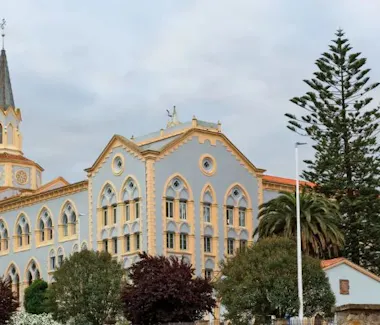
Abadía Cisterciense de Viaceli, Barrio los Corrales, Nº 191, 39320 Cóbreces, Cantabria, Spain
Santa María de Viaceli Cistercian Abbey
The Santa María de Viaceli Abbey is a Cistercian monastery, now home to a Trappist community dedicated to Saint Mary of Viaceli. Built between 1906 and 1910 in a striking Neo-Gothic style, it was founded by the monk Manuel Fléché Rousse, who also became its first abbot.
Constructed using reinforced concrete, the monastery is an architecturally harmonious complex arranged around a central cloister. Its elegant façade is distinguished by mullioned windows and pointed Gothic arches, reflecting the beauty and simplicity of Cistercian design.
Adjacent to the cloister stands the church, built on a Latin cross plan and financed by the brothers Manuel and Antonio de Quirós Pomar. In 1962, the original tower was destroyed after being struck by lightning and catching fire.
The monastery also houses a valuable historic library, making it not only a place of worship and contemplation but also an important cultural and architectural landmark in Cantabria.

Bo. Cóbreces, 94A, 39320 Cóbreces, Cantabria, Spain
San Pedro Ad Vincula Parish Church
The San Pedro Ad Vincula Parish Church, locally known as "the Red Church," is the parish church of Cóbreces and one of the village’s most distinctive landmarks. Built in a French Neo-Gothic style, it was inaugurated in April 1897.
The church features a Latin cross floor plan, two elegant towers on the main façade, ribbed vaults, a semi-circular apse illuminated by tall, slender windows, and a striking red octagonal dome above the crossing. Its lantern-style stained-glass windows allow an abundance of natural light to fill the interior.
The central nave is adorned with beautiful pointed-arch geometric stained-glass windows, while the choir, designed as a passage connecting the two towers, stands out for its impressive handcrafted overhanging structure.
The design was inspired by Norman Romanesque architecture and Gothic masterpieces such as Erfurt Cathedral. The church was financed by the Pedro José de Villegas Ruiz Foundation and built after the death of the wealthy businessman, in accordance with the wishes expressed in his will.

Bo. Cóbreces, 100, 39320 Cóbreces, Cantabria, Spain
House-Tower of the Villegas Family
The House-Tower of the Villegas Family is a historic manor that began as a medieval fortified tower and was transformed into a traditional Cantabrian country house during the 17th century by Miguel de Villegas, son of Juan de Villegas III Cevallos y Quevedo, the tenth Lord of Cóbreces.
His coat of arms and tomb can still be found in the chapel he founded within the Church of San Felices de Mies in Cóbreces, reflecting the family's long-standing influence in the region.
The tower's distinctive Neo-Gothic appearance, complete with battlements and inspired by the famous Alcázar of Segovia, was commissioned by Colonel Baldomero de Villegas. The design was intended as a tribute to the time he spent imprisoned in the Segovian fortress.
Today, the manor stands in the Corrales district of Cóbreces, serving as one of the village's most remarkable examples of noble architecture and local history.

Diseminado Cobreces, 4004, 39320 Cóbreces, Cantabria, Spain
Church of San Felices de Mies
The Church of San Felices de Mies is one of the oldest and most historically significant landmarks in Cóbreces. It was rebuilt around 1430 in a Renaissance-Gothic style on the site of the former Monastery of San Félix, which dates back to 943 AD.
The reconstruction was commissioned by Rodrigo de Villegas I, the eldest son and heir of Ruy Pérez de Villegas II, the first Lord of Cóbreces, and Teresa Díaz de Cevallos, a member of the noble House of Cevallos.
The church still preserves its original Romanesque bell gable and medieval Gothic doorway, both dating from around 1122, making it a remarkable example of Cantabria’s architectural heritage.
Its historic cemetery is home to a striking Christ sculpture created by the renowned Cantabrian artist Jesús Otero. Throughout the church and cemetery, visitors can also find numerous coats of arms and funerary monuments of the Villegas family, bearing witness to their role in the foundation and restoration of the building.
Although it ceased to serve as the parish church of Cóbreces in 1891, the church and its cemetery remain an important historical and cultural site, preserving centuries of local history and tradition.

Bo. del Pino, 43, 39320 Cóbreces, Cantabria, Spain
Villegas Foundation and San José School
The Villegas Foundation and the former San José School form one of the most representative historical landmarks in Cóbreces. Located in the El Pino district, this 18th-century complex is renowned for its traditional Cantabrian mountain architecture and for the important educational and social role it has played throughout its history.
The building was founded by Pedro José de Villegas under the patronage of Saint Joseph. From 1872 onwards, it was managed by the Sisters of Charity of Saint Vincent de Paul, who established a school for girls that served the local community for many years.
Today, the complex continues to be a vibrant cultural meeting place and is home to the Kaopreces Cultural Association, which organizes a wide variety of local events, exhibitions, and community activities, helping to preserve the traditions and heritage of Cóbreces.

Barrio Cóbreces, 39320, Cóbreces, Cantabria, Spain
Quirós Practical Agricultural Institute
The Quirós Practical Agricultural Institute is one of the most remarkable historic buildings in Cóbreces. Constructed between 1904 and 1906 by the brothers Antonio and Manuel Bernaldo de Quirós Pomar, it stands on the site of the family's original 17th-century manor house.
The building is distinguished by its elegant three-story manor architecture, a grand semi-circular entrance arch, and the original Quirós family coat of arms, reflecting the noble heritage of its founders. It remains an important part of the town’s architectural and cultural legacy.
Today, the former institute is home to Quirós Primary School (CEIP Quirós), continuing its long-standing educational tradition while remaining a significant landmark in the cultural and social life of Cóbreces.